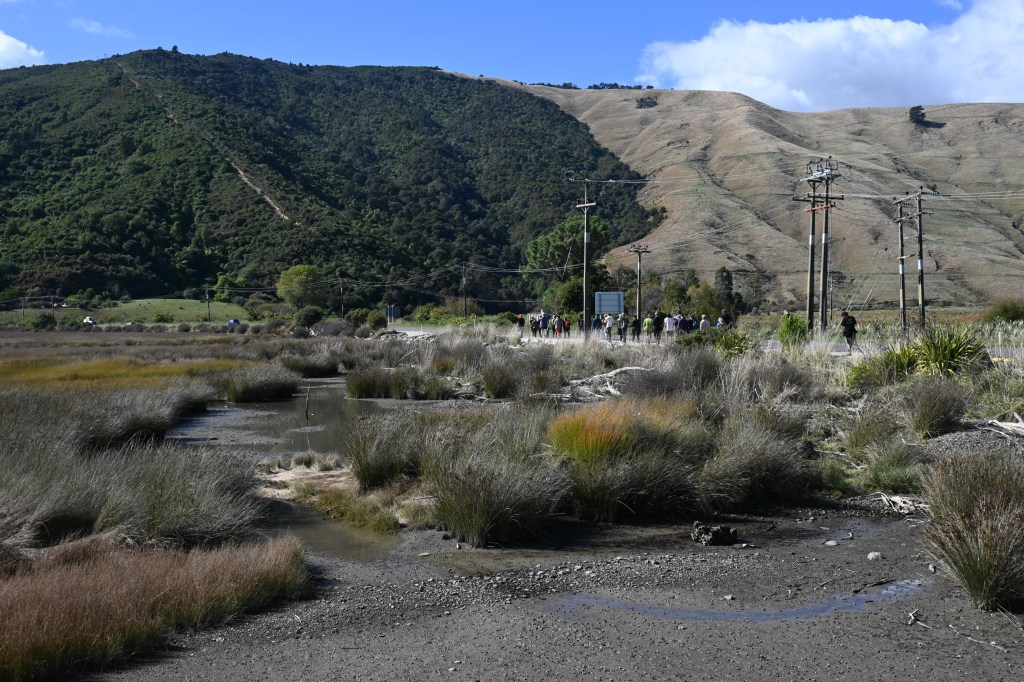
Photo by Sarah Wilcox DOC, 2025.
Community values are made up of a wide variety of learned and lived knowledge, experiences, world views, science and mātauranga. The driver for engaging with the community for this study is that low-lying coastal margin ecosystems in Marlborough are both unique and at risk from sea-level rise and climate change. Based on current expectations, climate change will directly impact these ecosystem types and their associated values for community members, landowners and iwi over the coming years. There is now an urgent need to develop adaptation strategies that can effectively address sea-level rise to ensure a sustainable future for these characteristic coastal ecosystems and the many benefits they provide for those who live, work and play there.
Local mātauranga, knowledge and perspectives matter in developing such strategies to build resilience and effectively protect these ecosystem types. Securing a long-term future for these ecosystem types can be enabled by identifying those who directly benefit from their conservation and sustainable management. Building connections to local values can motivate sustainable action for ecosystem-based resilience building and help to inform management decisions in the long run.
The participatory research for this study will co-produce and analyse participatory qualitative data and broad-scale habitat data to identify community perspectives and local values associated with coastal margin ecosystem types. In doing so it will also assess the spatial variance in place-based values through specific attention to case study sites identified in collaboration with the study participants.
The participatory research for this study aims to:
- Collaboratively identify case study sites of local significant coastal margin ecosystems for in-depth study,
- Co-produce informed qualitative data (science/ knowledge/ mātauranga) on local context, and
- Investigate the role of local context in applications of the selected assessment frameworks.
It is expected that several discrete case study sites will be identified for each of the coastal margin ecosystem types within the region to include examples of relatively unmodified and currently degraded ecosystem remnants.


 Resilient Coasts & Communities